If you are planning for Express Entry, one of the first things you need to understand is not just your total score, but why that score looks the way it does. Many applicants focus only on recent cutoffs, but that often leads to the wrong strategy. In practice, your CRS score is a structure made of several parts, and each part affects your chances differently.
That matters even more in Canada today because Express Entry no longer works as a single “highest score wins” system in every case. General rounds still exist, but program-specific and category-based rounds also matter. That means your next best move is often not “raise everything,” but “improve the part that changes your position the most.”
The Comprehensive Ranking System (CRS) is the official points system Immigration, Refugees and Citizenship Canada uses to rank candidates in the Express Entry pool. It does not decide whether you are legally eligible for Express Entry by itself. First, you must qualify under an Express Entry-managed program. After that, CRS decides how strong your profile is compared with other candidates in the pool.
Express Entry currently manages three main federal pathways: the Canadian Experience Class (CEC), the Federal Skilled Worker Program (FSWP), and the Federal Skilled Trades Program (FSTP). If you are eligible for one of these, you can enter the pool and receive a CRS score.
This distinction is important because many people mix up program eligibility with ranking strength. You may qualify for Express Entry but still have a score that is not competitive enough for a given round. That is why learning the CRS structure is the real starting point for strategy.
IRCC runs different types of invitation rounds: general rounds, program-specific rounds, and category-based rounds. In category-based rounds, candidates still need a CRS score, but they are ranked only against others who meet the category requirements for that round.
In other words, CRS still matters even when category-based selection helps you. It is not “category instead of score.” It is usually “category eligibility first, then CRS ranking within that eligible group.”
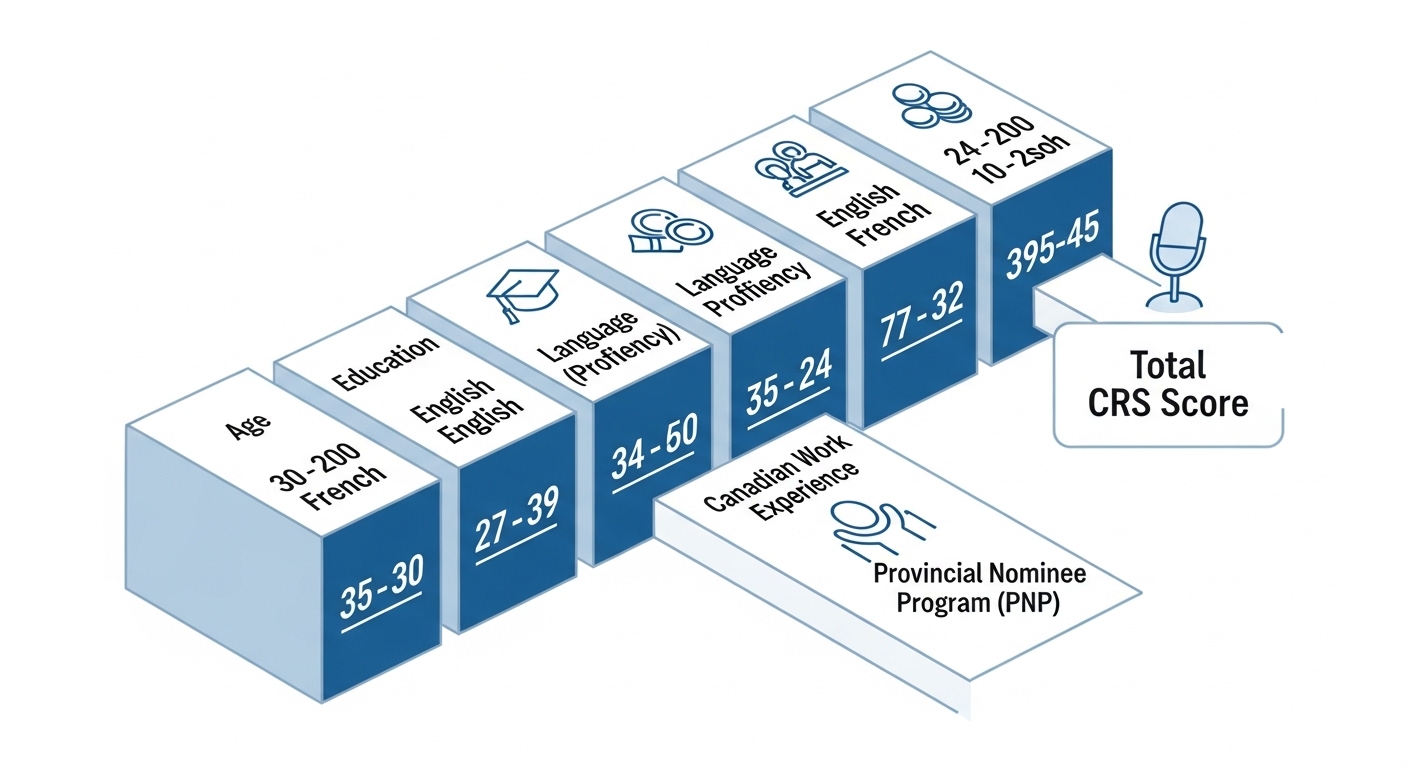
Your CRS score is made up of four broad layers. Looking at your profile through these layers makes it much easier to see what is helping you and what is holding you back.
This is the foundation of your profile. These points mainly come from your age, education, official language results, and Canadian work experience. For candidates without a spouse or common-law partner, this section can be worth up to 500 points. For candidates with an accompanying spouse or partner, it can be worth up to 460 points.
For many applicants, this is where the biggest baseline differences appear. A younger applicant with strong English or French results and Canadian work experience often starts with a much stronger foundation than someone who has good credentials but weaker language results.
If your spouse or partner is accompanying you, their education, language ability, and Canadian work experience can add points. This section can contribute up to 40 points.
This does not always mean bringing a spouse lowers your chances, but it does mean the structure changes. The profile needs to be reviewed as a combined strategy rather than as a single-applicant score.
This section rewards combinations that make your profile more valuable in the labour market. For example, education plus strong language results, or foreign work experience plus Canadian work experience, can increase your score here. This layer can add up to 100 points.
This is one of the most misunderstood parts of CRS. A person may improve only one variable, such as language, and suddenly gain much more than expected because stronger test results also unlock transferability points.
Additional points can dramatically change your ranking. Examples include 600 points for a provincial or territorial nomination, up to 50 points for French-language ability, up to 30 points for eligible Canadian post-secondary education, and 15 points for a sibling in Canada.
These are not small details. In many real cases, the difference between “waiting in the pool” and “becoming highly competitive” comes from this section.
When you read this table, the key point is that not all points are equally realistic to improve. Some applicants can retake a language test within months, but cannot suddenly gain Canadian work experience. Others may be much closer to a provincial nomination path than they think.
That is why a good CRS strategy starts with changeable variables, not just high-value variables. The best target is usually the factor that is both realistic and large enough to shift your ranking.
The most common mistake is treating CRS as one flat number. In reality, two candidates with the same total score may have very different strategic options. One may be close to improving language results and unlocking transferability points. Another may already be maxed out on language but need a provincial nomination or Canadian work experience to move further.
A second mistake is assuming that a high score in one area can always offset weakness elsewhere. Sometimes it can, but sometimes it cannot. For example, strong education alone rarely compensates for weak language results as effectively as people expect.
A third mistake is relying on outdated score assumptions. Since job-offer CRS points were removed, many older calculators, forum posts, and agency-style summaries no longer reflect today’s reality.
Scenario 1: You are an overseas applicant with strong education but average language scores.
Your total may look decent at first, but your real growth opportunity is often language. Better language results can lift both core points and transferability points at the same time.
Scenario 2: You already have Canadian study or work experience.
Your profile may become more efficient to improve because Canadian experience and Canadian education can support both your base score and additional points strategy.
Scenario 3: Your score is far from recent competitive ranges.
This is usually the point where you should compare PNP routes, French-language strategy, or category-based eligibility rather than hoping small profile edits will change the result.
In a general round, you compete broadly with candidates eligible for one of the three Express Entry programs. In a program-specific round, you compete only within the targeted program group. In a category-based round, you first need to meet the category requirements, and then CRS still ranks you against others in that category.
This is why understanding your CRS is only step one. Step two is knowing which kind of round your profile can realistically target. For some applicants, general-round competitiveness matters most. For others, category-based selection or PNP-linked strategy is a more practical route.
One common mistake is comparing your score to random online claims instead of official round data and the official CRS calculator. Another is spending too much time on low-impact changes while ignoring the factor that actually drives most of the gap.
It is also common for future immigrants planning from outside Canada to focus only on one invitation type. In reality, your profile should be reviewed through several possible routes: direct Express Entry competition, category-based opportunities, and provincial nomination strategy.
Before trying to predict whether you will receive an invitation, map your profile in this order:
If you are building a broader permanent residence plan, start with our Canada permanent residence fastest paths guide. From there, the next useful reads are usually how to increase your CRS score, Express Entry cutoff trends, Express Entry and PNP strategy, and language test scores and CRS points.
There is no single safe number because invitation rounds vary by type and by time. A score that is not enough in a general round may still become more competitive if you qualify for a category-based round or receive a provincial nomination.
No. Canada removed CRS points for job offers on March 25, 2025. However, a valid job offer can still matter for eligibility under some programs or pathways.
No. Category-based selection works alongside CRS. You must meet the category requirements, and then IRCC ranks eligible candidates by CRS score within that category-based round.
That depends on your profile, but language results, French ability, provincial nomination, and strategy around Canadian experience often create the largest meaningful changes.
Yes. A spouse’s education, language test results, and Canadian work experience can add points. In some cases, reviewing both partners’ profiles strategically is worth more than focusing on only one person’s score.
After calculating CRS, compare whether your better route is direct Express Entry competition, a provincial nomination path linked to Nova Scotia, or a broader settlement plan based on work, language, and timeline.
Your CRS score is not just a number to check once. It is a decision tool. The more clearly you understand which part of the score is doing the work, the easier it becomes to choose the right next step.
To check your current Express Entry score using the official Government of Canada tool, visit the official CRS calculator.