If you are already comparing Canadian permanent residence options, the next mistake many people make is choosing a province first and only then looking at the stream details. In practice, that often leads to wasted time, higher document costs, and applications built around the wrong requirement.
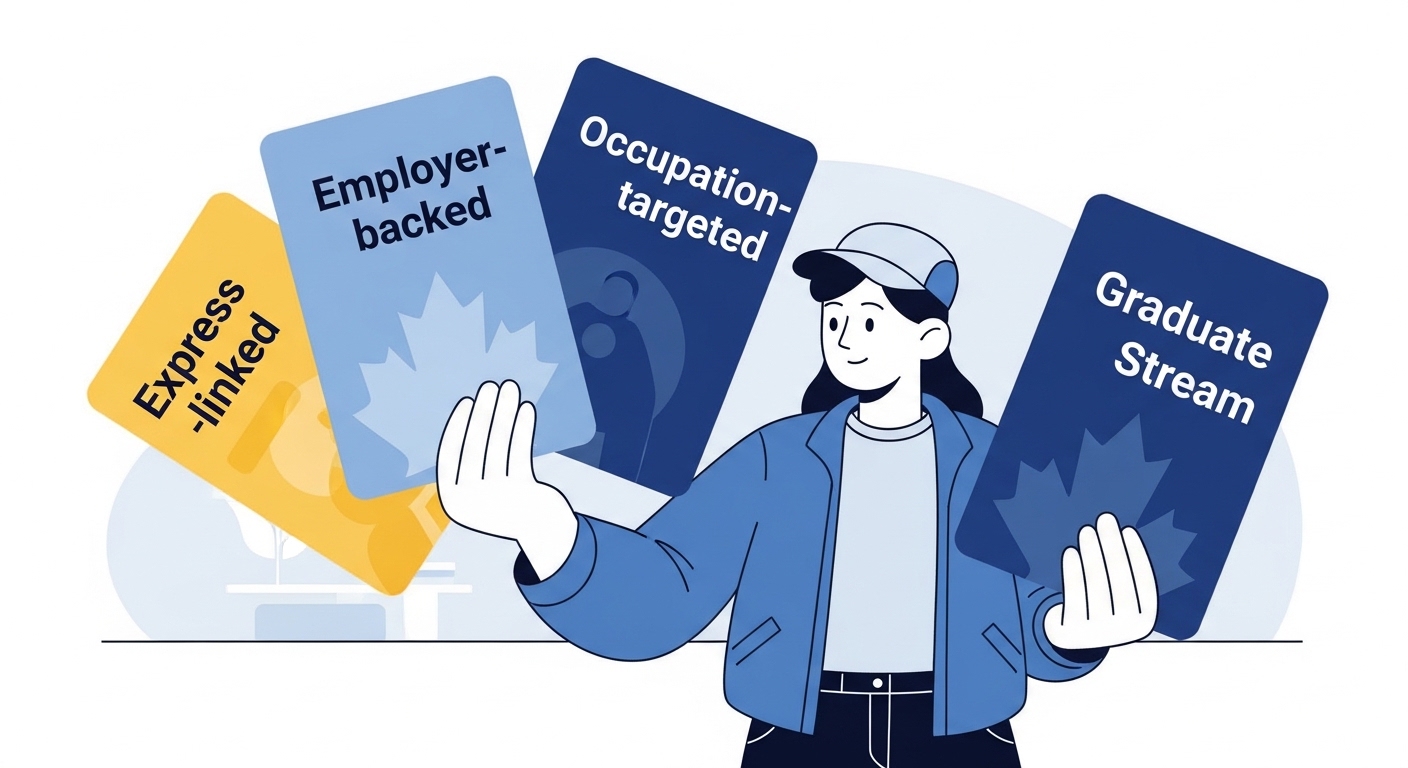
What usually matters first is not whether Ontario, British Columbia, Saskatchewan, or Nova Scotia sounds more attractive. It is whether your profile fits an Express Entry-linked stream, an employer-backed stream, an occupation-targeted stream, or a graduate-focused stream.
That difference matters even more for newcomers, international students, and job seekers trying to settle in Canada with a realistic plan. In Halifax, Nova Scotia, for example, a person with local study history may need a very different decision path from someone outside Canada with a strong occupation profile but no job offer.
If you have not narrowed your overall pathway yet, start with our fastest realistic PR route in Canada guide before comparing provincial stream types.
The biggest reason applicants lose time is that they read PNPs as province lists instead of decision systems. A province can have multiple streams, and only one or two may actually fit your profile.
Start with these four questions:
If yes, an Express Entry-linked PNP stream may give you a faster or more structured route to nomination. If not, a non-Express Entry stream may be the more realistic starting point.
If your strongest advantage is employer support, employer-backed streams often matter more than your CRS score. This is common for workers already in Canada or people with a provincial employer ready to hire them.
Some provinces prioritize certain sectors or shortage occupations. In those cases, occupation fit may matter more than the province’s general popularity.
International graduates sometimes have access to stream families that are easier to assess than general worker categories, especially when local education and labour market needs align.
Many applicants chase the provinces they hear about most often. That sounds logical, but it can be expensive. A “popular” province is not automatically a better option if your profile only matches one weak stream there.
For example, one applicant may have a decent federal profile but no employer support. Another may have average CRS-style competitiveness but a strong local job offer. Putting both people into the same province-first research path creates confusion. They should be comparing different stream families from the start.
When reading this table, focus on what gives you leverage, not what sounds easier on social media. A stream can look attractive on paper but still be a poor fit if your job offer, federal eligibility, occupation, or study history is weak in that specific category.
For many applicants, the right reading order is simple: first identify your strongest evidence, then check which stream family uses that evidence most directly, and only after that compare provinces.
Here is the most practical way to narrow the list.
Start with Express Entry-linked PNP options. These are often worth checking first when your language, education, and work history already make you federally competitive. In this situation, the province is supporting an existing profile rather than replacing it. If you may qualify through an EE-linked stream, read Express Entry CRS score explained first so you know whether direct Express Entry or provincial nomination makes more sense.
Look at employer-backed streams first. This applies to many temporary workers and some job seekers who already have a serious employer relationship in Canada. In this case, the quality and continuity of the job offer matter more than province branding.
Check occupation-targeted pathways first. This is often the better starting point for applicants in health care, trades, childcare, agriculture, transport, or other shortage-driven sectors, depending on provincial priorities.
Review graduate-focused streams before general worker categories. International students often waste time competing in broad streams when a graduate-specific route may match their profile more directly.
For readers planning around Halifax, Nova Scotia, the decision often feels smaller because the local ecosystem is easier to map than the largest provinces. But that does not remove the same basic question: are you stronger as a graduate, as a worker with employer support, or as a candidate whose profile fits a specific labour need?
In smaller labour markets, stream fit can matter even more because the wrong assumption is harder to hide. A weak job offer strategy stays weak. A profile that depends on local retention or genuine settlement plans needs to be credible. That is why Nova Scotia readers should be especially careful not to copy a province-first strategy built for someone in Toronto or Vancouver.
If Nova Scotia is part of your shortlist, check is Halifax good for immigration before building your plan around one province.
A recent international graduate in Canada:
If your biggest advantage is local study history and recent integration into the Canadian labour market, graduate-focused streams may deserve your attention before broader worker streams.
A worker with a serious employer relationship:
If a provincial employer is ready to support you, employer-backed routes may be more practical than trying to force your case into a profile-led path.
An applicant outside Canada in a targeted occupation:
If you do not have local study or a Canadian job offer, your best angle may be a province that actively values your occupation rather than a province with the strongest name recognition.
Choosing the wrong stream is not just an eligibility problem. It often becomes a money and timing problem too.
The most important line in this comparison is not processing speed. It is rework. Many applicants do not lose because their profile is weak; they lose because they build around the wrong requirement first.
In practical terms, the cheapest stream is often the one that lets you avoid rebuilding your plan three months later.
This is the most common error. Province comes after fit, not before it.
A job offer can be powerful, but only when it matches the stream’s rules and remains viable through the process.
Large provinces get more attention, but attention is not the same as fit.
Your long-term plan matters. Housing, local labour demand, licensing, and retention expectations can change whether a stream is realistic for you.
A Canadian education is helpful, but not every province rewards it in the same way.
Before spending more time on any one province, make a shortlist using these filters:
This is also where internal comparison becomes useful. If you have not yet narrowed your overall PR route, read our parent hub first: Fastest Canada PR Route. If you are already inside the PNP decision stage, this article should help you decide what kind of stream to study next.
If your profile is still broad, do not try to compare ten provinces at once. Start by placing yourself into one of four stream families: Express Entry-linked, employer-backed, occupation-targeted, or graduate-focused.
For most applicants, it is better to identify the right stream family first. After that, province comparison becomes much more accurate and less overwhelming.
No. Some streams are employer-backed, while others are linked to Express Entry, occupation targeting, or graduate pathways. The real issue is which requirement your profile can support best.
Not always in exactly the same way, but province-specific study history often matters. That is why graduate pathways should be checked carefully instead of treated as interchangeable.
They can be, especially if your occupation is the main reason a province may prioritize your profile. In that case, labour market fit may matter more than broad popularity.
They often copy strategies built for larger provinces without checking whether their real strength is local study history, employer support, or a sector-specific match in Nova Scotia.
It is spending on documents and planning for a stream that does not actually match your strongest eligibility factors. Rework is often the most expensive part.
The smartest PNP strategy usually starts with a smaller question: what is your strongest proof point? Federal profile, job offer, occupation, or study history? Once that is clear, the province list becomes easier to read and the risk of choosing the wrong path drops sharply.
For official program details, always verify with government sources before acting, including IRCC and the province you are targeting. If you are comparing your broader PR options first, go back to our parent guide and then return here once you know PNP is realistically on your shortlist.
Check IRCC Provincial Nominee Program overview
Check IRCC Express Entry-linked PNP process
Check IRCC non-Express Entry PNP process