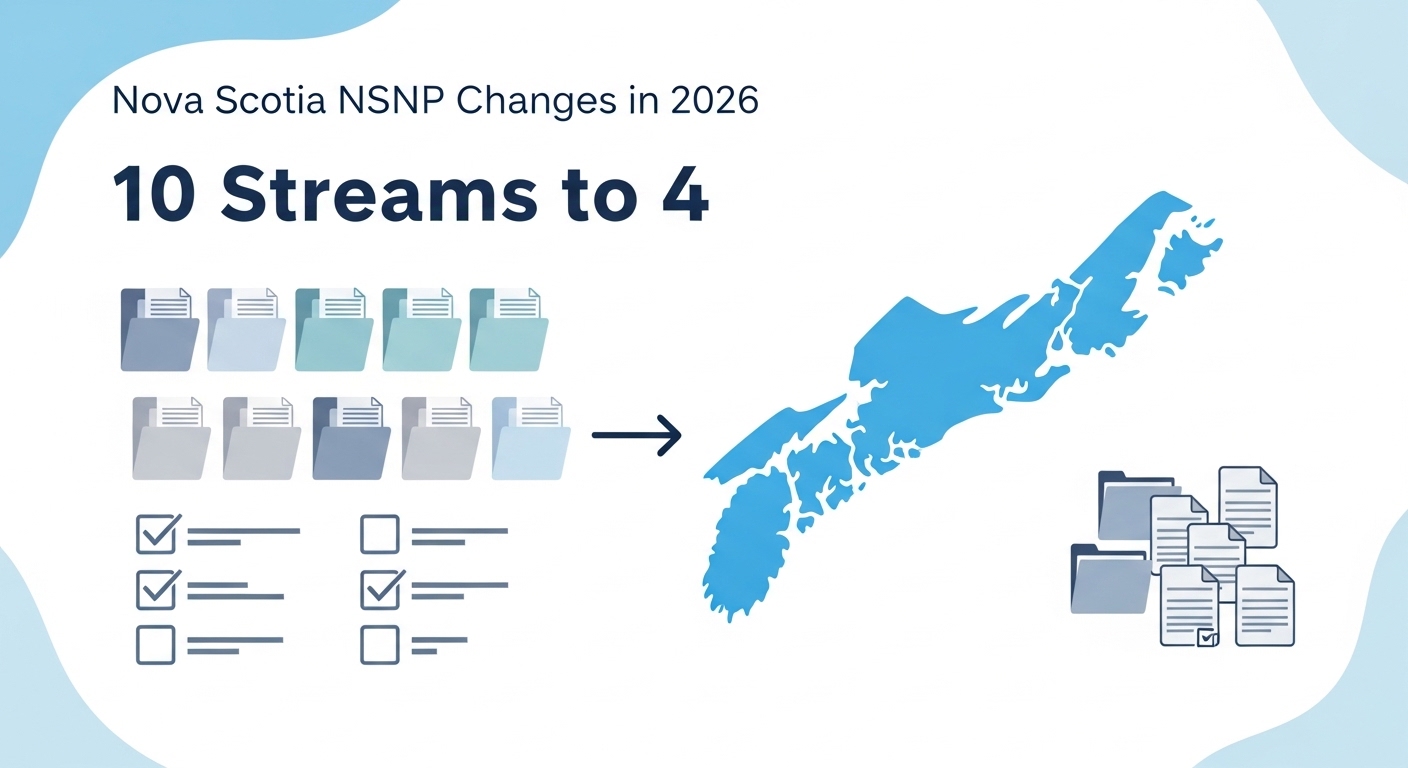
Nova Scotia’s immigration system looks different in 2026, but the biggest change is not what many applicants first assume. The province did not suddenly wipe out every old pathway. It reorganized the NSNP into a simpler structure.
That matters because most people are asking three different questions at once: what changed on February 18, 2026, whether existing EOIs are still valid, and whether the Atlantic Immigration Program changed too. Those answers are not the same. And that’s where confusion starts.
February 18, 2026 is the key date. Nova Scotia consolidated the NSNP from 10 streams to 4.
Existing EOIs remain active. If your EOI was already in the pool, no separate action was required just because of the consolidation.
AIP was not affected by this NSNP restructuring.
New applicants should now assess their case using the current 4-stream structure, not older stream labels alone.
The temporary portal closure matters mainly as a caution for people who leave submissions unfinished during system transition periods.
If you are thinking about Nova Scotia as your immigration destination, this update changes how you read the program. It does not automatically change whether you qualify. That’s the real difference.
For many applicants, the better question now is not “Which old stream was mine?” but “Which of the 4 current streams now fits my profile, and do I need to do anything right now?”
If you are still deciding whether Halifax or Nova Scotia is even the right fit for your long-term plan, it helps to step back and compare the bigger picture first through this Halifax immigration fit guide. Honestly, that kind of context makes the NSNP update easier to interpret.
Nova Scotia reorganized the Nova Scotia Nominee Program into four main streams:
The important part is this: many older pathways did not simply disappear. In many cases, they were folded into a broader stream and now appear as sub-criteria rather than standalone stream names.
So yes, the structure is simpler on the surface. But applicants still need to read the details carefully. And most people miss that.
The most important thing in this table is not the old stream name. It is the current category that now holds your case.
If your plan depends heavily on Express Entry, this is also the point where you should compare your current profile with your CRS position. A practical next step is to review how Express Entry scores work in Canada before assuming NSNP is automatically your best route.
This is the part many applicants were most worried about. If your EOI was already in the NSNP pool before the consolidation took effect, it remains active.
You did not need to resubmit it just because the stream names changed. You also did not need separate action just to keep your place in the pool.
Bottom line: if you already submitted a valid EOI, the structural update itself was not the reason to panic.
If you want to confirm this directly from the province, use the official update below.
Check the official NSNP update
New applicants should treat February 18, 2026 as the dividing line between the old structure and the current one. That means you should not rely on outdated stream lists alone.
Ask whether you fit best as a graduate, a worker with employer support, an entrepreneur, or an Express Entry-linked candidate. That is a more useful starting point than chasing retired stream labels.
Some pathways still exist in substance, even if the standalone stream name is gone. This is especially relevant in physician-related and priority-sector cases.
NSNP may be the right move for you. But it should not be viewed in isolation. If permanent residence is your main goal, it is worth comparing it with the broader landscape in this guide to Canada PR routes before deciding your next step.
Simple, but it matters.
The temporary portal closure was part of the transition period. It ran from February 13 to February 18, 2026.
If someone had an EOI in progress but did not submit it before the deadline, that draft could be cancelled automatically and the progress might not be saved. During the closure, applicants also could not upload additional documents.
That is mostly a cautionary lesson for new applicants now: when Nova Scotia announces a system update window, do not leave important submissions half-finished.
If you need the transition timeline and portal closure details, use the official page below.
Visit the official portal update
One of the biggest mistakes in 2026 has been assuming the NSNP consolidation changed everything connected to Nova Scotia immigration. It did not.
The Atlantic Immigration Program was not affected by this specific NSNP restructuring. So if your pathway depends more on employer support and long-term settlement planning, you should assess AIP on its own terms rather than assuming the NSNP update changed everything.
The key thing to notice in this table is scope. NSNP changed. AIP did not change because of this update.
If your plan also involves study-to-work-to-PR decisions, this is where related pathways start to matter. For example, applicants comparing post-study options may also need to check PGWP eligibility in Canada, while families who depend on two incomes should also review spousal open work permit options. That broader context can change which route feels realistic.
If your plan may fit the Atlantic route instead, review AIP separately.
Using old stream names as if they still define the program. In many cases, the practical pathway still exists, but under a broader stream.
Assuming an existing EOI became invalid. For most people already in the pool, that is not what happened.
Mixing NSNP changes with AIP rules. They may overlap in geography, but they are not the same program.
Reading the temporary portal closure as a long-term shutdown. It was a transition step, not a permanent freeze.
Long story short: the structure changed, but your next move depends on the program bucket that actually matches your case.
Not exactly. Nova Scotia consolidated the old 10-stream structure into 4 current streams on February 18, 2026. Many older pathways still exist in practice, but now sit inside broader streams as sub-criteria.
If your EOI was already in the NSNP pool, no separate action was required just because of the consolidation. Existing EOIs remained active.
No. The February 2026 NSNP consolidation did not affect the Atlantic Immigration Program. AIP should be assessed separately.
In-progress EOIs had to be submitted before the announced deadline. Otherwise, they could be cancelled automatically and progress might not be saved.
Not by itself. The main benefit is clarity in program structure. You still need to meet the criteria that fit your case.
Start by identifying whether your case fits Nova Scotia Graduate, Skilled Worker, Entrepreneur, or Nova Scotia: Express Entry. Then review the current official criteria under that stream.
The 2026 NSNP update matters, but not because it automatically changed every applicant’s outcome. The biggest shift was structural clarity: 10 streams became 4 on February 18, 2026.
For existing EOI holders, that was mostly reassuring. For new applicants, the real task is mapping your case to the current structure instead of relying on old stream labels. And for AIP users, the key point is simple: this particular NSNP update did not rewrite your program.
If you want the next decision step, start with the current NSNP structure, compare it against your actual profile, and then branch out only where needed. That usually leads to better choices than trying to memorize every old stream name.
If you want to review the current stream structure itself, start with the official NSNP page.