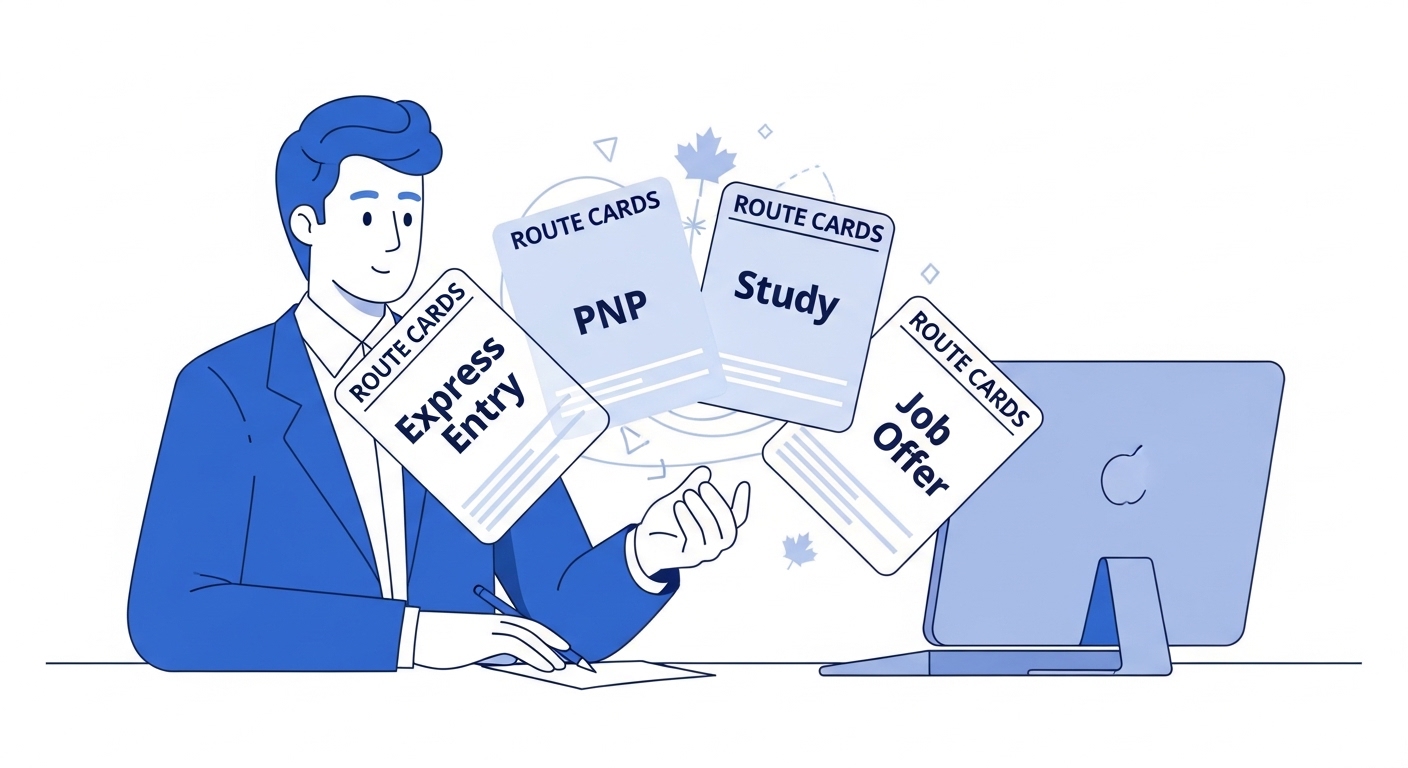
Many people search for the fastest way to get permanent residence in Canada, but that question is usually asked the wrong way. The real decision is not “Which route looks fastest on paper?” but “Which route is the fastest one I can actually complete without losing time, money, or legal status?”
That matters even more in Canada now because immigration policy is moving more often than many older blog posts suggest. Express Entry categories have changed, PGWP rules are no longer as simple as they used to be, and spouse open work permit eligibility is much narrower than many applicants assume. If you are comparing Express Entry, PNP, study, and employer-backed work options from Halifax, Nova Scotia, or anywhere else in Canada, the best route depends heavily on your starting profile.
In practice, most applicants fall into one of five groups:
If you skip this profile split and just ask for the “fastest PR route,” you can end up choosing a path that looks short but fails at the eligibility stage.
A few years ago, many people treated study in Canada as the default safe route. That is no longer a safe assumption. Not every program leads to the same PGWP outcome, not every student spouse can get an open work permit, and not every Canadian credential creates a realistic PR result.
The same is true on the PR side. Direct Express Entry can be excellent for the right candidate, but it is not equally realistic for everyone. PNP can look slower on paper but may actually be the faster realistic path when it gives you a nomination or when it targets your occupation. In Atlantic Canada, some people also overlook employer-driven pathways such as the Atlantic Immigration Program, which can matter more than broad province lists.
This is where the decision changes. The right comparison is not speed alone. It is speed + realism + cost + failure risk + spouse impact.
If you already have strong language scores, recognized education, and skilled work experience, direct Express Entry is usually the cleanest route. It avoids the tuition-first gamble and can be cheaper than spending years in a study-first plan.
This group often includes people with one or more of the following:
For this group, the biggest mistake is delaying action while waiting for “perfect timing.” If your profile is already close to viable, spending money on a random college program may actually slow you down.
Check how your Express Entry score works before you assume you need a second route.
Many people misuse PNP research by reading province lists instead of stream logic. That leads to weak decisions. The better question is not “Which province is easiest?” It is “Which stream matches my current profile without forcing me into a dead-end move?”
In practical terms, PNP selection usually works through one of these patterns:
For Halifax and Nova Scotia readers, this is especially important. A province is not a shortcut by itself. A stream only works when your job type, employer situation, settlement plan, and timing line up with that stream’s rules.
Compare province stream types before choosing a destination just by reputation.
Study can still be the right route, but only when it is selected as part of a bigger plan. The weak version of this strategy is “go to Canada first and figure it out later.” The stronger version is “choose a program, province, and work outcome that can realistically improve my PR position.”
Study-first may make sense if:
But this route carries the highest upfront cash risk. Tuition, living costs, and time loss can be severe if the program is poorly chosen. It is even riskier if you assume your spouse will automatically get an open work permit or if you assume every program leads to an equally useful PGWP outcome.
Review PGWP eligibility rules and spouse work permit limits before paying a deposit.
An LMIA-backed job offer or another employer-supported work route can be useful, but it should not be confused with guaranteed PR. The work permit step and the PR step are related, not identical.
This route tends to work best when:
The biggest mistake here is paying for fake job offers, weak recruiters, or vague “guaranteed LMIA” promises. A job offer can improve your route. It does not remove policy risk or replace proper eligibility planning.
See how LMIA-based routes actually work before treating a job offer as a PR approval.
The most important line in the table is not the speed column. It is the combination of upfront cost + main risk. A route that looks slower can still be the better choice if it has a much higher chance of leading to a real PR result.
For example, a weak study plan can cost far more than a patient PNP strategy. On the other hand, a strong EE-ready profile should usually not be pushed into a tuition-heavy route just because it feels safer emotionally.
Use this order when comparing provinces:
Is your main strength your CRS score, your occupation, your employer, your Canadian education plan, or your spouse profile? That tells you which stream family is worth reviewing first.
Do not compare provinces generally. Compare stream types that match your facts now. A transport worker, early childhood educator, nurse, tradesperson, Atlantic employer candidate, or international graduate may each fit very different routes.
If you are targeting Nova Scotia, New Brunswick, or another smaller market, make sure the job market, rent, spouse employment options, and local employer demand actually support your plan. A stream is stronger when you can realistically live and work there, not only when it looks good online.
Case 1: High CRS overseas applicant
You already have strong language results, a recognized degree, and skilled work experience. In this case, direct Express Entry is often more efficient than paying for Canadian study first.
Case 2: Married applicant with average CRS
You want to come with your spouse, but your CRS is not comfortably competitive. Here, a targeted PNP or an employer-linked Atlantic route may be more realistic than a generic diploma plan, especially if spouse work rights are uncertain.
Case 3: Applicant rebuilding profile from a weak starting point
If your language score, work history, or education position is too weak for direct PR, study can still work. But the program must be chosen with PGWP rules, local work prospects, and the later PR bridge in mind.
The best route is usually easier to see when you strip away the marketing language and focus on your starting condition.
It is often the fastest route for people who are already competitive, but not for everyone. If your CRS is weak, a targeted PNP or a structured work or study pathway may be more realistic.
On paper, not always. In real life, it can be faster for people who are unlikely to receive a direct EE invitation and need a nomination-based route.
It can still work, but it is no longer automatically safe. Program choice, PGWP eligibility, local job access, and later PR strategy all matter much more than many older articles suggest.
Sometimes, yes, but the rule is narrower than before. It depends on the type and length of your program and whether it fits the current eligibility categories.
No. It may help you get a work permit or strengthen a later immigration strategy, but it is not the same thing as PR approval.
That depends on whether your strength is a direct PR profile, an Atlantic employer connection, or a realistic provincial stream fit. Nova Scotia can be a strong option when your job type and settlement plan match the route, not simply because it looks smaller or cheaper.
The fastest realistic Canada PR route is the one that fits your profile today without creating a bigger failure risk tomorrow. For some people, that is direct Express Entry. For others, it is a targeted PNP, an Atlantic employer path, or a carefully chosen study plan with a real post-graduation strategy.
Your next step should be simple: identify which asset is strongest right now—CRS, occupation, employer, study plan, or spouse profile—and build from there.
Because Canada immigration pathways can change, it is safest to verify the current official rules before paying tuition, accepting a job offer, or submitting an application. Use the official pages below to confirm the latest criteria for Express Entry, PGWP, spousal open work permits, and LMIA-related processes.
Visit Official IRCC Express Entry page
Visit Official PGWP page
Visit Official spousal and family open work permit page
Visit Official LMIA and Temporary Foreign Worker Program page